The Lékédi Biodiversity Foundation and its Park are located near the town of Bakoumba, a small town in the Haut-Ogooué province, in the southeast of the Republic of Gabon.
Bakoumba and the Lékédi Park share a long common history, marked by a transition of local activities from manganese transportation to environmental and tourism-related activities.
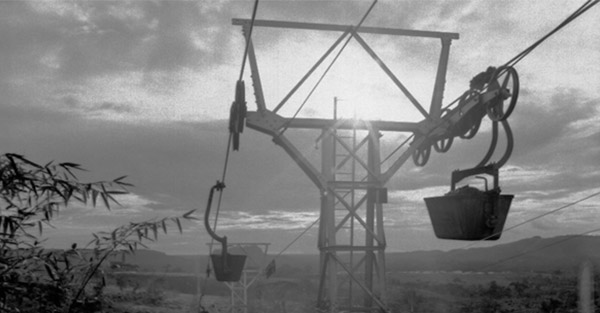 Before the Lékédi Park, an industrial cable!
Since the 1960s, the Compagnie Minière de l’Ogooué (COMILOG) has been operating the manganese mine in Bangombé, located in Moanda.
Until November 1991, the ore was transported from Moanda to Congo via a 76 km monocable aerial tramway, the longest in the world. It passed through a dense forest to reach M’binda, its arrival point in Congo, before being transported by rail to the port of Pointe-Noire and transferred onto bulk carriers delivering the manganese to clients across the globe.
Bakoumba is located halfway between Moanda and M’binda. This small town of 2,500 inhabitants hosted a COMILOG community. Its personnel were responsible for maintaining the aerial tramway. Bakoumba’s intermediate position allowed maintenance teams to quickly intervene in the northern or southern sectors.
The Birth of the Park
In 1986, the commissioning of the Transgabonais railway provided Comilog with direct access to the sea via Owendo, making it unnecessary to transport ore to Pointe-Noire. Since the cableway was no longer needed, the economic and social activity ensured by Comilog’s presence could disappear.
Aware of the dilemma posed by the cessation of its activities in Bakoumba, Comilog undertook to propose a reconversion of part of the existing workforce and facilities by creating a wildlife park, one of whose purposes was livestock farming and fish farming. This was a way to maintain local activity, ensure the sustainability of the social fabric, and promote methods aimed at improving the area’s food self-sufficiency.
This is how the Lékédi Park was born, covering 14,000 hectares today, built thanks to Eramet Comilog funds.
In 2021, the Lékédi Biodiversity Foundation was created to structure and sustain the long-standing actions in favor of scientific research and biodiversity conservation. The Lékédi Biodiversity Foundation’s mission is to support research and innovation programs, strengthen biodiversity conservation, and promote awareness and training. It relies on a network of academic, institutional, and associative partners while developing its own initiatives.