Savanna Program: Towards Sustainable Restoration
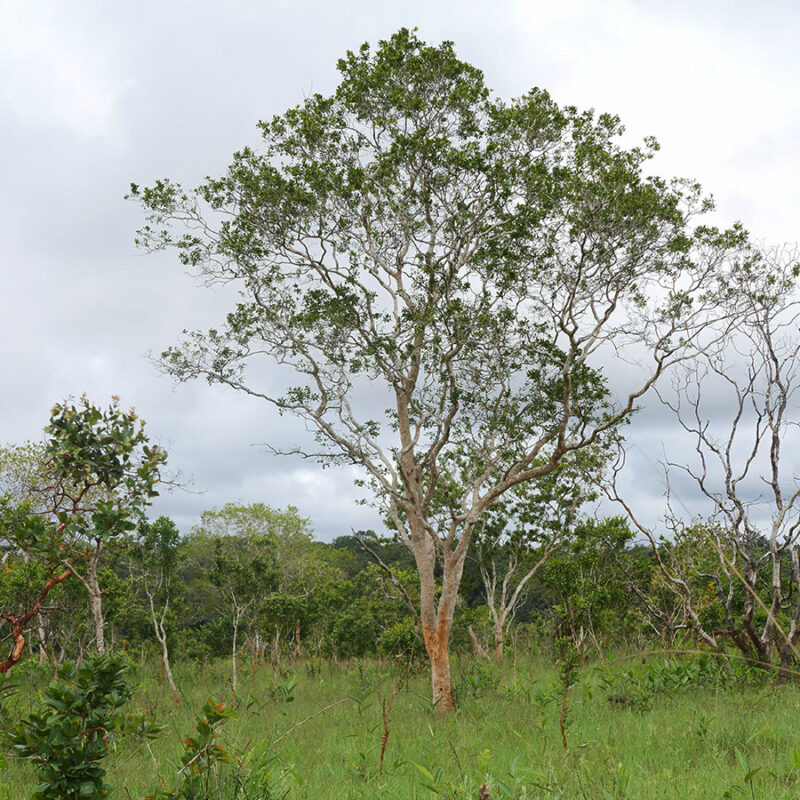
The savanna program was initiated with the Biodiversity service of Eramet Comilog for the implementation of biodiversity compensation related to the opening of a new mining area in 2020. Initially, studies of the savannas were conducted in Moanda to understand the different associated vegetation formations and the key species that determine the quality and health of these habitats. The characterization then continued on the savannas of the reserve.
Currently, we are testing the impact of ruminants on the savannas and developing new restoration practices that promote symbiosis. These practices could be deployed on a large scale.
Preventing and combating invasive species
Invasive alien species (IAS) are one of the main drivers of biodiversity loss worldwide. Indeed, human activities have facilitated the introduction and spread of these species in environments they would not naturally colonize.
Laos grass, scientifically known as Chromolaena odorata, is an invasive plant that poses a serious ecological problem in the Gabonese savannas. Originally from Central and South America, this species was accidentally introduced to Africa and has rapidly spread due to its ability to colonize various habitats.
Its rapid growth and ability to smother local plants make Laos grass a threat to the biodiversity of the Gabonese savannas. It depletes soil nutrients, disadvantaging native species and disrupting local ecosystems. Combating this invasive plant is essential to preserving the health and diversity of Gabon’s habitats.
In response to the proliferation of Laos grass at a site of interest, the Foundation conducted trials in 2023 and 2024 to control this invasive species. Three methods were tested:
- Complete stump removal: This method offers quick results but temporarily exposes the soil. Careful handling is necessary to avoid damaging the soil and the seed bank of endemic species.
- Foliage reduction followed by stump removal: The rapid growth of Laos grass depletes soil nutrients, which disadvantages native species.
- Clear-cutting without stump removal: The results are similar to those of the previous method.
Complete stump removal gives excellent results, although it is labor-intensive. The rainy season is particularly favorable, as it stimulates the growth of local species.
Mandrillus Project: Understanding primates to better protect ecosystems
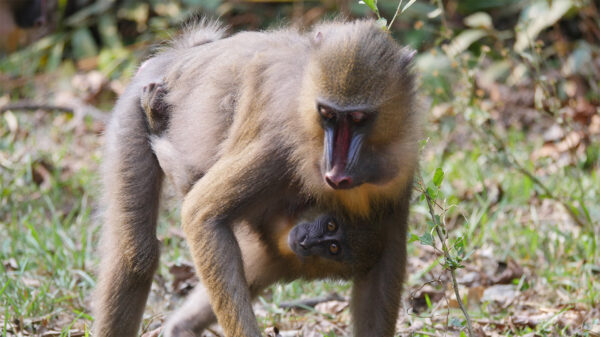
Since 2012, the Foundation has hosted the Mandrillus project in its reserve, managed in a tripartite manner by the CNRS, the Institute of Evolutionary Sciences of Montpellier (ISEM), and the Interdisciplinary Center for Medical Research of Franceville (CIRMF).
Its goal is to address fundamental questions in evolutionary ecology, anthropology, food ecology, and animal communication; but also to respond to questions of conservation and epidemiology. The central questions of the project concern the evolution of sociality (kin selection, host-parasite relationships).
This project is made possible thanks to a unique context provided by the reserve: among the various groups of mandrills (+300) that roam freely in the Park, some are accustomed to humans, allowing researchers to approach and observe them in their daily lives. A team of researchers is housed at the Lékédi Park and collects data daily or occasionally.
The Mandrillus project uses advanced technologies, such as artificial intelligence and deep neural networks, to analyze thousands of mandrill portraits. This has demonstrated natural selection favoring an increased facial resemblance among members of the paternal family.
In 2024, the project published several articles, notably in the scientific journals iScience, Royal Society Open Science, and Primates, on:
- The beneficial impact of social relationships on health and longevity through the diversification of microbiomes,
- The birth of younger siblings leading to a reduction in maternal care for older siblings, without increasing conflicts or anxious behaviors, unlike other mammals,
- The rare observation of a daytime birth revealing perinatal behaviors of the mother and the group.
Future technologies at the service of biodiversity
As part of its research and innovation approach, the Lékédi Biodiversity Foundation collaborates with the Open Innovation team of Eramet Ideas, the research and innovation center of the Eramet group, as well as with Comilog, to develop new ecological monitoring approaches.
This partnership, conducted in collaboration with the British start-ups Mozaic Earth and Gentian, explores the combination of satellite imagery, artificial intelligence, and connected field surveys. The objective is clear: to better understand, assess, and preserve biodiversity by designing modern, accessible, and reproducible tools for the sustainable management of ecosystems in Gabon.
This proof of concept aims to design, deploy, and validate an evolving biodiversity monitoring system, applied to the Comilog mining site and the Lékédi reserve. Thanks to very high-resolution satellite images, automated AI analyses, and geolocated field observations via smartphone, the system enables:
- detect the presence of invasive exotic plant species (IES),
- assess the ecological state and plant diversity of five savanna plots,
- and demonstrate the feasibility of an integrated, reliable, and economically viable solution for environmental monitoring.
The experimentation is based on four complementary steps. It begins with the mapping of habitats using satellite images, enhanced by AI to identify sensitive areas and invasive species. A smart sampling phase then guides field surveys according to ecological variability. Ground-truthing, carried out by local teams trained on the Mozaic Earth mobile application, allows for the collection of photos and geolocated data, even offline. Finally, partner ecologists analyze the information, refine AI models, detect invasive alien species (IAS), and produce dynamic dashboards for monitoring purposes.
Beyond the scientific proof, this project illustrates the capacity for collaborative innovation among industrial, scientific, and technological stakeholders. It directly adds value to Eramet’s environmental strategy and biodiversity conservation in Gabon, laying the groundwork for a reproducible model of intelligent ecological monitoring.